From Weeks to Minutes: What Google's AI-Powered Migration Assessments Teach FinOps About Vendor Cost Discovery
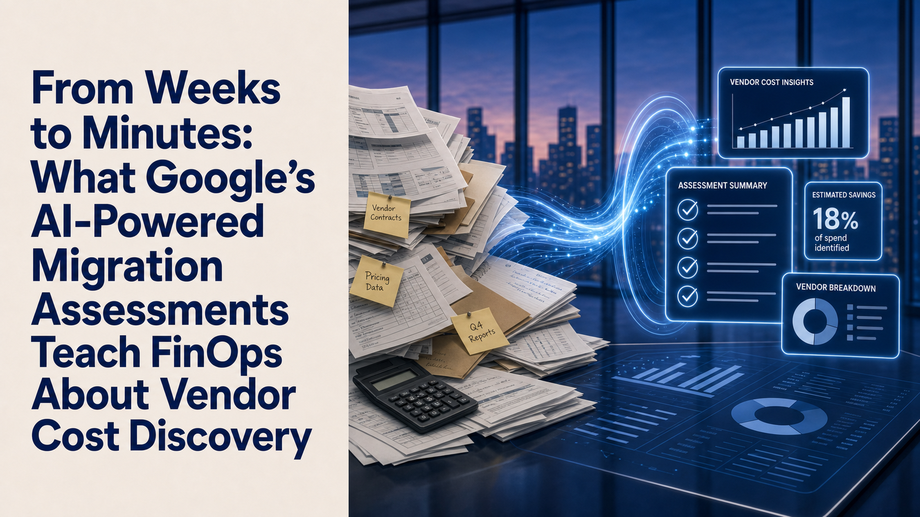
Google Cloud just shipped a pointed admission about how most infrastructure cost decisions actually get made: badly, and slowly. Its new AI-powered Quick Assessments in Migration Center exist because, as the company puts it, legacy discovery can mean "weeks of manual spreadsheet analysis, mapping in-house infrastructure, and reconciling siloed, piecemeal cost estimates across disparate teams and sources." Manual discovery, Google notes, can delay migration timelines by months, increase engineering overhead, and produce miscalculated financial models — before a transformation initiative even launches.
The fix Google built is straightforward: ingest raw infrastructure data or cloud billing reports, and in minutes rather than months, generate an optimized target bill of materials, service mapping coverage, and projected savings. An agentic assistant explains the underlying financial assumptions, recommends technical cost optimizations, and exports a ready-to-share executive report. What used to be a multi-week cross-team reconciliation project becomes a same-day output.
The Same Failure Mode, a Different Line Item
Strip away the cloud migration framing and the underlying problem Google is describing isn't specific to infrastructure at all. It's the generic failure mode of cost management everywhere data lives in silos: spend information scattered across billing exports, contract PDFs, and departmental spreadsheets, with no single team positioned to reconcile it before a decision is due. Google is solving this for compute migration. FinOps teams face the identical structural problem for vendor and SaaS contract spend — and the cost of getting it wrong is the same: decisions get delayed, or they get made on stale, incomplete numbers.
Ask any FinOps or procurement team how long it takes to answer "what would we actually save by consolidating these two overlapping tools?" or "what's our real TCO on this vendor once usage, discounts, and contract terms are all accounted for?" The honest answer, for most teams, is still measured in days or weeks of manual reconciliation — the exact pattern Google is racing to eliminate on the infrastructure side.
Mapping the Pattern to Vendor Cost Management
Google's Quick Assessment capability set translates almost feature-for-feature into what proactive vendor cost management needs to look like.
Instant TCO estimates from raw inputs. Google converts VMware inventory exports into precise Compute Engine cost targets. The vendor-management equivalent is converting raw contract data and spend history into an accurate total cost of ownership per vendor — not just the invoice line, but usage trends, discount tiers, and renewal terms combined into one number a team can actually act on, generated automatically rather than rebuilt in a spreadsheet every quarter.
Automated service mapping and coverage. Google's assessment produces a bill of materials showing what infrastructure maps to what target service. In vendor management, the same automation should surface which tools overlap, which licenses sit unused, and which contracts nobody has mapped to an actual owner — the redundancy and coverage gaps that manual tracking routinely misses because nobody has time to cross-reference 130+ SaaS contracts by hand.
Context-aware guidance that shows its work. Google's agentic chat explains the financial assumptions behind its recommendations rather than presenting a black-box number. That's the same standard vendor intelligence tools should be held to — a renewal recommendation or savings estimate is only useful if the underlying contract terms, usage data, and pricing history behind it are visible and auditable, not asserted.
A business case that's ready to share. Google's feature exports directly to a spreadsheet with the recommended BOM, TCO comparison, and ROI analysis built in — because the output of a cost assessment isn't useful until it reaches the person who has to approve the decision. Vendor cost recommendations need the same endpoint: a report finance or procurement can act on immediately, not raw data that still needs to be turned into a narrative.
Why This Matters Beyond Cloud Infrastructure
Google's framing of the payoff is worth sitting with: comprehensive financial models in minutes instead of months isn't just a productivity win, it's what actually lets a modernization initiative launch on schedule instead of stalling in the discovery phase. The same is true for vendor cost decisions. A renewal negotiation that should happen 60 days before a notice window closes often doesn't happen until the deadline is already visible, precisely because assembling the usage data, contract terms, and pricing history to negotiate from a position of leverage takes longer than the team has. Automating that discovery is what turns a reactive renewal into a proactive one.
This is the same problem Asozal exists to close for vendor and contract spend — automated vendor research, contract data enrichment, and renewal alerting that replace the spreadsheet reconciliation Google is describing, applied to the SaaS and vendor contracts most FinOps teams still track manually.