The FinOps Vendor Intelligence Checklist: What to Track Before Q4 Budget Season
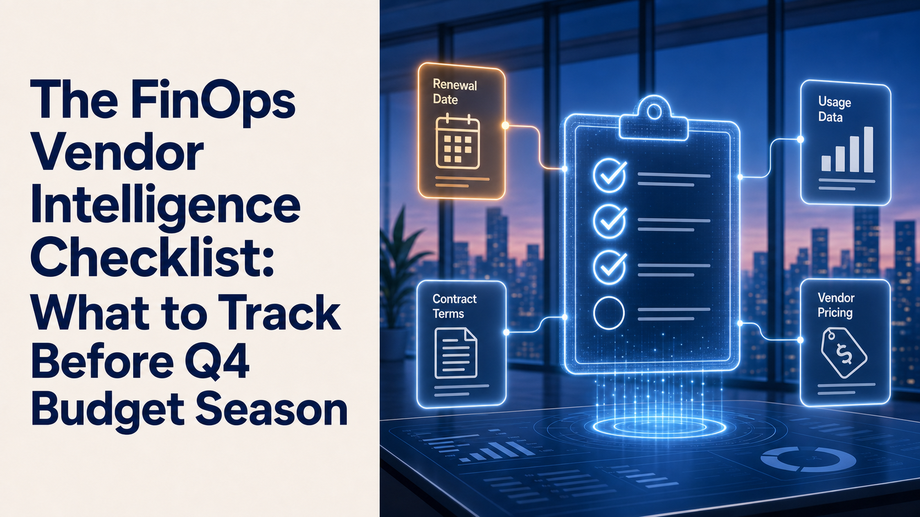
Q4 budget season has a predictable rhythm: finance asks for next year's vendor spend numbers, procurement pulls contract folders that haven't been opened since renewal, and someone on the FinOps team discovers a pricing tier change, a stale license count, or an auto-renewal clause nobody flagged in time. By the time the budget model is due, the vendor data feeding it is already out of date.
This is the recurring failure mode behind vendor cost tracking: teams have spend data, but not vendor intelligence. Spend data tells you what you paid last month. Vendor intelligence tells you what's about to change — pricing, renewal terms, usage trends, and risk posture — before it hits the budget. Enterprises now run an average of 130+ SaaS applications, and roughly 51% of purchased licenses go unused, the highest waste rate on record (CloudNuro). Zylo's 2025 SaaS Management Index puts average annual waste from unused licenses alone at around $21 million for large enterprises (Zylo). And 62% of organizations report being caught by an auto-renewal they never intended to execute (Procr). None of that shows up cleanly in a spreadsheet until it's already a budget line you didn't plan for.
Why Budget Season Exposes the Gaps
Most vendor tracking lives in a patchwork: a contracts folder in Dropbox, a spend export from the accounting system, a Slack thread where someone mentioned a price increase six months ago. That patchwork works fine day-to-day, because nothing forces it to be complete. Budget season forces it to be complete — and that's exactly when the gaps get expensive. A missed renewal notice window locks in another year of spend. A pricing change that wasn't logged means next year's forecast starts from the wrong baseline. A usage trend nobody tracked means the team can't tell finance whether a renewal should shrink, grow, or disappear.
This is the core distinction FinOps teams evaluating vendor intelligence tools should be making: are you comparing tools that track spend, or tools that track the vendor relationship itself — contract terms, pricing history, usage, and risk, together, in one system of record?
The Checklist: What to Track Before You Build Next Year's Budget
Before you finalize Q4 numbers, run every active vendor contract through this list. These are the data points that most commonly get missed, and each one directly changes a budget forecast if it's wrong.
- Renewal date and notice window. Not just the renewal date — the exact number of days of advance notice required to cancel or renegotiate, and whether that window has already opened.
- Auto-renewal status. Whether the contract renews automatically at the current term, a longer term, or an increased rate if no action is taken.
- Contracted rate vs. current list price. Vendors change list pricing more often than they update long-tenured customers. A contract signed two years ago may no longer reflect what new customers pay — in either direction.
- License or seat utilization. Active users against licensed seats. This is the single fastest way to spot the 51% waste rate mentioned above inside your own vendor portfolio.
- Multi-year discount and commitment clauses. Whether a lower rate is tied to a volume or term commitment that resets — potentially at a worse rate — at renewal.
- Owner of record. Every vendor should have one named internal owner responsible for the renewal decision. "Nobody" is not an acceptable answer during budget season.
- Historical spend trend. Twelve to twenty-four months of actual spend per vendor, not just the current invoice, so a forecast is based on trend rather than a single data point.
- Overlap and redundancy. Two tools solving the same problem in different departments is one of the most common — and most fixable — sources of Q4 budget surprises.
That's eight of the checklist items. There are more that matter just as much — including vendor risk posture changes, contract escalation clauses, and how to sequence renewal conversations across a portfolio so you're never negotiating from urgency.
Turning the Checklist Into a Repeatable Process
A checklist is only useful once — a system is useful every quarter. That's the difference between running this exercise manually in a spreadsheet every Q4 and having renewal dates, pricing history, usage data, and ownership already centralized when budget season starts.
This is the specific gap Asolzal's product is built to close: automated vendor intelligence enrichment that keeps contract terms, pricing changes, and usage trends current in one place, instead of reconstructed under deadline every year. If you want to see how the platform maps to the checklist above — renewal alerts, contract amortization, and audit-ready vendor records — the pricing page breaks down what's included at each plan level, and the FAQ covers common questions on integrations, data import, and setup time for teams migrating off spreadsheets.
Budget season goes a lot smoother when the vendor data is already accurate the week finance asks for it. Start free with 10 vendor records and see what your own portfolio looks like once renewal dates, pricing history, and usage are finally in one place — before Q4 numbers are due, not after.